Overview
Mango BoostX™ NRT is an NVMe-oF target accelerator card that offloads the NVMe/RoCEv2 data path to dedicated hardware. It exports the NVMe SSDs installed in the enclosure to remote hosts at line rate without consuming host CPU cycles, which makes it suited to headless JBOF (Just a Bunch Of Flash) systems that have no application CPU of their own. A configuration daemon on the card discovers the installed SSDs at boot and publishes them according to a single policy file, so the enclosure serves storage without any command being run by hand.
Highlights
JBOF-Ready NVMe/RDMA Target
- Headless NVMe/RDMA target accelerator for JBOF storage enclosures
- NVMe-oF storage expansion at low system power
Zero-CPU I/O Path
- Line-rate performance at 200GbE
- No CPU consumption in the NVMe-oF I/O path
- Direct communication with the NVMe SSDs without CPU intervention
Interoperability and Compatibility with Standards
- Compatible with RoCEv2 standardized infrastructure
- NVMe-compliant solution certified by UNH-IOL
Supported Hardware
NRT 1x200GbE (HHHL)
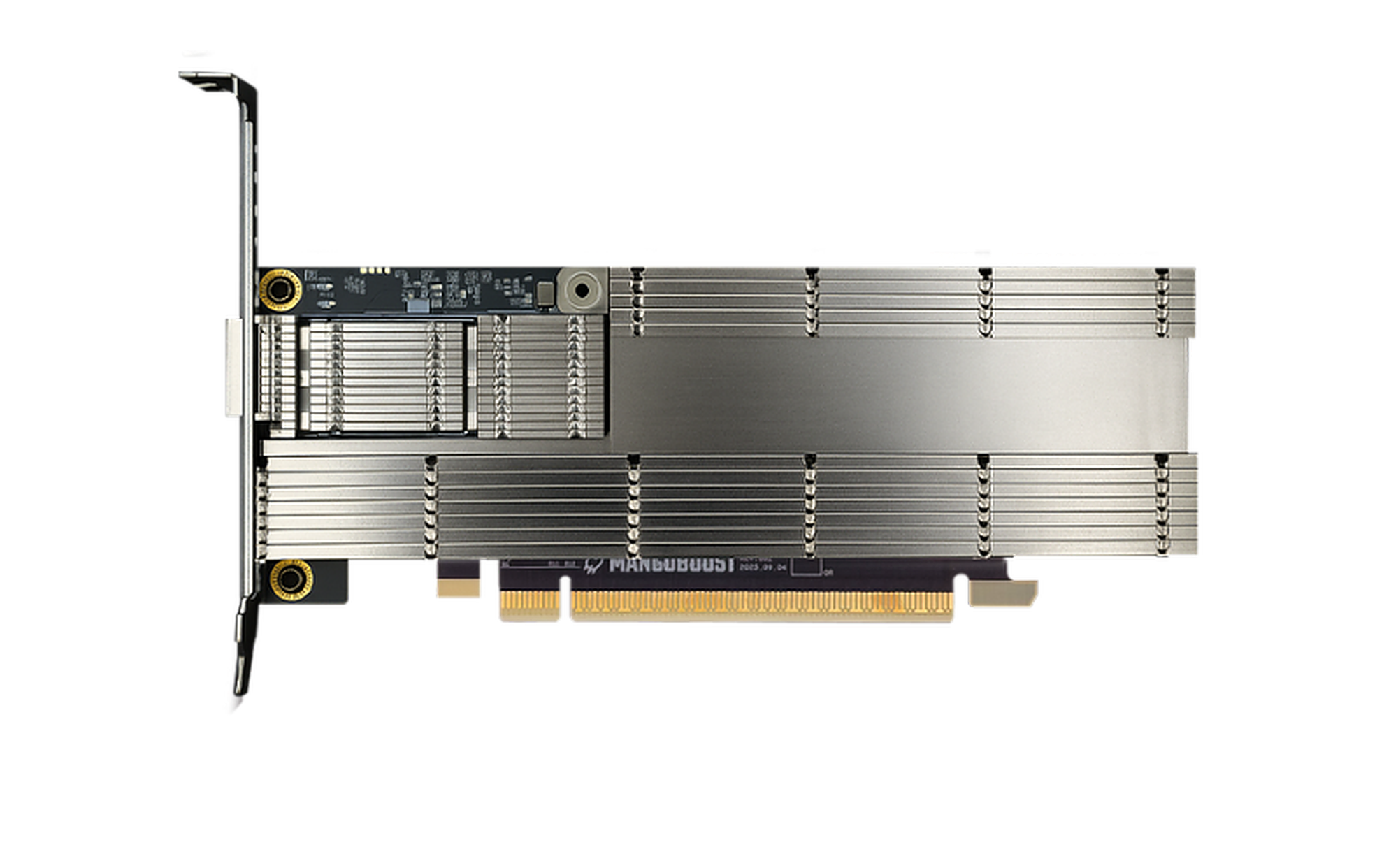
Hardware Specification
Network Interface
- 1x QSFP-DD port
- 1x 200GbE support
- Support active and passive cables
- 4500-byte MTU
PCIe Interface
- PCIe Gen5 x8
- Root Complex
Form Factor
- HHHL, single slot
- PCIe add-in card
Processing Unit
- 2x Arm Cortex-A72
- 2x Arm Cortex-R5F
Memory
- 8GB LPDDR4, ECC support
- 256MB OSPI flash
- 64GB eMMC flash
Management
- PCIe in-band management
- MCTP over SMBus
- FRU (Field Replaceable Unit)
- UART
Environmental
- Maximum power consumption: 75W
- 12V, 3.3V, 3.3V_AUX input voltage via PCIe gold finger
- Operating Temperature: 0°C to 55°C
- Operating Relative Humidity: 20% to 80%
- Storage Temperature: -20°C to 60°C
- Storage Relative Humidity: 10% to 90%
Regulatory
- FCC/CE/KC
- UL/RoHS
RDMA Features
- Configuration-free RoCEv2
Capabilities
| Item | Value |
|---|---|
| Hosts | Up to 32 |
| NVMe-oF I/O queue pairs | Up to 32 |
| NVMe-oF queue depth | 32 entries |
| NVM subsystems | Up to 26 |
| NVMe SSDs | Up to 26 |
| Namespaces per SSD | 1 |
| Logical block size | 512 B |
| Maximum data transfer size (MDTS) | 128 KiB |
Standards Compliance
Certified by the University of New Hampshire InterOperability Laboratory (UNH-IOL).
- NVM Express® Base Specification 2.2
- NVM Command Set Specification 1.1
- NVMe over RDMA Transport Specification 1.1
System Components
| Component | Runs on | Role |
|---|---|---|
mango-jbof | Card | systemd service that configures the appliance at boot. The default operating path |
mango-ctl | Card | CLI for managing the appliance. The nvmf subcommand controls the NVMe-oF target |
mango-smi | Card | Device and sensor summary |
| NVMe-oF target daemon | Card | The target itself, started manually by mango-ctl nvmf start or automatically by mango-jbof |
| NVMe-oF initiator | Customer host | Connects with nvme connect |
This guide assumes the Linux in-kernel NVMe-oF initiator, driven with nvme-cli on the host. Other initiator implementations are not covered.
Operating Modes
There are two ways to configure the appliance, and they are not meant to be used at the same time.
- Automatic (recommended).
mango-jbofconfigures the network interface, discovers the SSDs, and creates the subsystems, namespaces, and listeners at boot. You only edit the policy file. See Automatic Configuration. - Manual. You run the
mango-ctl nvmfcommands yourself. Intended for special layouts and for diagnosis. See Manual Configuration.
If the automatic service is enabled, it re-applies its own policy and reverts a configuration you built by hand. To keep a manual configuration across restarts, pin it with mango-ctl nvmf autoconfig --commit-state, or disable the service with mango-ctl nvmf autoconfig --disable. See Pinning the Running Configuration.
Command Results
Every mango-ctl nvmf subcommand reports its result through its exit code, so scripts should branch on the code rather than on the text of the output.
| Code | Meaning |
|---|---|
| 0 | success |
| 1 | the operation ran and failed |
| 2 | missing, invalid or conflicting arguments |
| 3 | the NVMe-oF service is not running |
| 4 | subsystem, controller or device does not exist |
| 5 | refused: destructive, re-run with -f/--force |
| 6 | refused: connections or resources still in use |
Code 3 is the expected result before the target has been started. See Exit Codes for the rules that apply between them.
Where to Go Next
- Hardware Setup — cabling, drive population, and management access
- Software Setup — verifying the installation, the service, and network configuration
- Automatic Configuration — the policy file and the standard operating procedure
- Manual Configuration — the
mango-ctl nvmfcommand reference - Initiator Setup — connecting from the host and the I/O queue budget
- Monitoring and Diagnostics — checking state and collecting support data
- Troubleshooting